


Q: CompanyCSR and our readers would like to know about the mission behind “Raise the Flag”, how and when you decided to support People with Visual Impairments (Blind) with Tech innovations and your present status on this.
We chose the name “Raise the Flag.” in the hope that people will use our products and services to transform their lives for the better—and ultimately raise their own flags.
The name also serves as a constant reminder to ourselves that we must create products and services powerful enough to make that kind of impact.
One day in 2017, I heard a girl who was completely blind say:
“Not being able to see is inconvenient, but it does not make me unhappy.”
I was deeply moved—and relieved—to know that she did not consider herself unhappy. At the same time, I began wondering what products or services existed to address the inconveniences she faced.
I searched throughout the night, but I could not find anything that truly solved them. That was when I decided to create such a product myself—and it became the starting point of this venture.
Today, our vision is to bring SYNCREO, the product we are developing, to people around the world and create a future in which people with visual impairments can look back and say:
“There was a time when living without sight was difficult.”
In addition, after SYNCREO is launched, we plan to begin developing products that help prevent people from becoming completely blind, with the aim of reducing—even by one—the number of people who need SYNCREO.
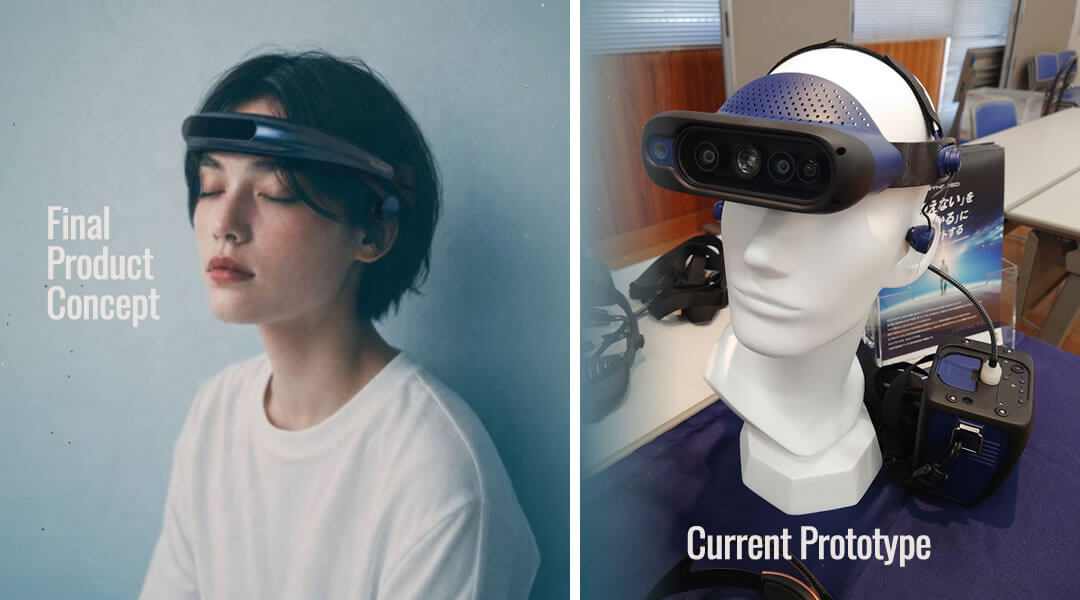
Q: Raise the Flag, has developed products ranging from the Mizuiro Clip to the much more sophisticated SYNCREO. What does your product journey tell us about how assistive technology (AT) should be designed around real-life needs ?
For example, we are considering converting the colors of objects in front of the user into sounds and incorporating those new sounds into SYNCREO’s existing audio and haptic feedback. Users may find this confusing at first, but once they become accustomed to it, they may be able to perceive a greater amount of information.
Ultimately, I believe the only way to move closer to the right answer is through repeated real-world testing, including long-term user trials.
It is also important to talk with many people with visual impairments before turning the idea into a concrete feature.
Q: At Present, SYNCREO combines environmental recognition, sound, vibration and AI to help users understand their surroundings. What do you believe is the most important technological breakthrough still required before such solutions can become truly mainstream?
Rather than a technological breakthrough, I believe that creating many real-world success stories with SYNCREO will be the key to its widespread adoption.
Imagine, for example, that a person using SYNCREO could perform the same work as a sighted person. They could then earn a standard wage, rather than the lower wages often associated with employment for people with disabilities. This could enable them to support their family—or even purchase a SYNCREO for someone else.
Imagine going to a café and seeing someone wearing SYNCREO, peacefully enjoying time alone, or having a lively conversation with friends or family. Or imagine that the person serving your drink is wearing SYNCREO.
In other words, what changes could we bring to society—and to a country—if SYNCREO enabled people who have traditionally been regarded as recipients of support to become taxpayers?
I believe that such success stories would give hope to children with visual impairments and to their parents.
People may fail, and they may even experience despair. But when they discover a new source of hope, they can begin moving forward again.
That is why we are developing SYNCREO.
Technology will continue to advance every day, whether or not we drive that progress ourselves. We intend to harness those advances and use them to continuously evolve SYNCREO. So this does not mean that we are unaware of, or indifferent to, the importance of technological breakthroughs.
What we want is to remain faithful, every day, to our corporate philosophy:
“Giving form to our love and creating hope.” That is what matters most to us.Q: Japan has a highly developed ecosystem around technology (AI &Robotics), accessibility, what is your broader vision for using tech solutions/apps to create greater independence and participation for people with functional impairments (disabilities).
Escalators that can accommodate wheelchair users and “Ekimatope” displays, which present ambient sounds and station announcements as text in real time, are accessibility solutions that Japan can be proud of. However, because they are not installed throughout the country, the number of people who can benefit from them remains limited.
At the heart of both independence and social participation is the ability to make one’s own choices and act on them. In other words, it is autonomy.
To make choices, people need access to a wide range of accurate, real-time information.
I believe this is where technology-based solutions and applications can play an important role—by enabling people to obtain the information they need.
This can bring about a shift from being someone who requires assistance to being someone who can act independently. As a result, the social participation of people with disabilities will advance significantly.
Today, many people find that their choices have already been closed off before they even have the opportunity to try, simply because they begin from different starting points or live in different environments.
What truly matters is not only refining the ways in which we assist people, but also refining the ways in which people can become independent.
So that everyone, with or without a disability, can become the person they aspire to be. That, I believe, is the right way to use technology.
Q: You are visiting & participating in Zero Project Conference, Mumbai, what are you most interested in understanding about India’s disability and AT ecosystem during this visit?
I would like to learn what assistive technologies are currently available, what needs remain unmet, and what hopes and expectations people have for the future.
I hope to discover how we can contribute to making the world a better place.
I am truly grateful for this opportunity.
Q: India and Japan have very different demographic, user economic and social environments, where do you see the strongest opportunities for the two countries to collaborate especially for affordable AT & digital innovations, frugal engineering and large-scale deployment?
Japan has a strong culture of precision manufacturing, safety, quality control, and product development that carefully incorporates users’ voices. India, meanwhile, has extensive expertise in frugal engineering: identifying the functions that are truly necessary and turning them into practical, affordable solutions despite limited resources. India also has the ability to conduct evaluations across diverse living environments and user groups, and to deploy solutions at scale through digital technology. I believe the strengths of the two countries are highly complementary.
What is important here is not to take an expensive product completed in Japan and introduce it into India without modification. We should collaborate from the earliest stages of development with people with disabilities in India, as well as support organizations, businesses, universities, and government bodies, to jointly design the necessary functions, pricing, delivery methods, and maintenance systems. Possible approaches include modular designs that allow users to select the functions they need, local sourcing and manufacturing, the use of existing smartphones and digital infrastructure, and shared-use models supported by businesses or public institutions. In other words, we should consider systems that do not rely solely on the individual purchase price.
Affordability does not simply mean reducing quality or functionality. It means clearly identifying the functions that provide genuine value to users and redesigning the entire system—including design, manufacturing, distribution, and maintenance—in a sustainable way.
With SYNCREO as well, we do not envision a one-way relationship in which Japanese technology is simply sold in India. We want to evaluate it collaboratively across India’s diverse environments and develop it into a simpler and more affordable solution. The knowledge gained through this process can benefit not only India, but also aging societies such as Japan and regions around the world where support resources are limited.By combining Japan’s ability to enhance quality with India’s ability to deliver essential value to more people, we can transform assistive technology from a specialized product available to only a limited number of people into accessible, everyday technology that everyone can choose. I believe this represents the greatest potential for collaboration between our two countries.
Q: The Zero Project brings together innovators and organisations from across the world and beyond showcasing individual technologies, what do you believe international platforms like this need to achieve to turn promising innovations into solutions that reach people at scale especially for Global South region.
No matter how advanced a technology may be, it is difficult to make it widely available to people in the Global South if it remains based on the pricing, language, institutional systems, and living environments of the country in which it was developed. What is needed is not the one-way introduction of a finished product, but the redesign of its essential functions, pricing, delivery methods, and maintenance systems together with local people with disabilities, support organizations, businesses, universities, government bodies, and other stakeholders.
For this reason, I believe platforms such as the Zero Project are expected to play at least three roles.
The first is to connect innovators with implementation partners who have a deep understanding of local challenges and users.
The second is to provide access to the funding, institutional frameworks, and evaluation methods needed to progress from small-scale pilot projects to public procurement, commercialization, and large-scale deployment.
The third is to share not only success stories, but also knowledge gained from pricing decisions, localization, implementation challenges, and failures, and to develop models that can be replicated in other countries and regions.
I believe these are the three essential roles.
What is particularly important is creating a mechanism that allows collaboration to continue after an event has ended. Simply meeting at an international conference and conducting a single pilot project is not enough to achieve social implementation. Long-term support is required to monitor progress over several years and assist with local partnerships, fundraising, impact evaluation, and engagement with institutions and policymakers.
It is also important to evaluate not only how many devices have been delivered, but also how many people have gained access to education or employment, and how many have become able to make their own choices and take action. Alongside the scale of adoption, we should measure the changes created in users’ lives and social participation.
I hope the Zero Project will evolve from a place where innovations are showcased into an international platform that connects people with disabilities, innovators, implementation organizations, funders, and governments, and supports them through to real-world implementation. By doing so, it can help transform outstanding technologies from specialized solutions available to only a limited number of people into practical options accessible to people around the world.
Q: Looking towards the next five years, what would you like to see emerge from Japan–India collaboration in disability inclusion and assistive technology space —and what role do you see in Raise the Flag playing in that future?
In that future, Raise the Flag. hopes to serve not merely as a company that brings Japanese technology to India, but as a bridge connecting people with disabilities, engineers, businesses, support organizations, and government bodies in both countries. We want to evaluate SYNCREO together with people in India, adapt it to the country’s living environments, culture, and economic circumstances, and expand it as a sustainable business.
Our role at Raise the Flag. is to create, through collaboration between Japan and India, many tangible success stories in which people wearing SYNCREO can travel independently, learn, work, support their families, and create new value for others.

